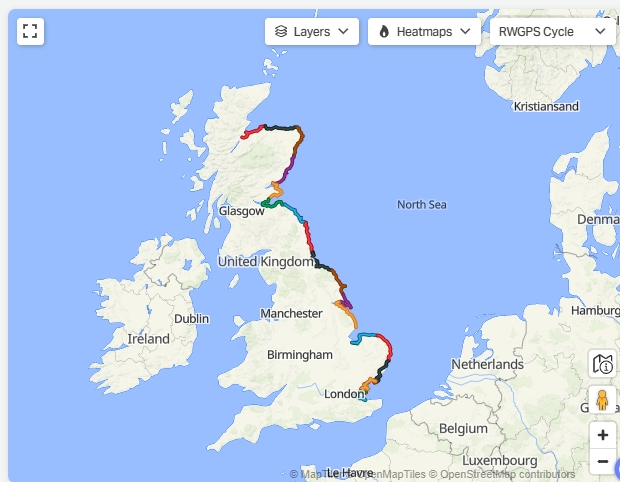
East Coast 2025

DAY 0 – Training

Jim pitched up before 8 this morning to take me to Bristol Parkway to catch a train to Inverness, the northernmost city in the United Kingdom if you ignore The City and Royal Burgh of Kirkwall which is, technically, a mere town. We didn't need to leave until about 0845: that is until Jim remembered that his phone and wallet were still at his house. Fortunately his house is roughly on the way to Bristol so we left Home Farm at 0830, picked up the missing goods and proceeded. Jim's car is subject to the Bristol Ulez so we needed to find a way round the zone which involved a lot of minor roads and then dicing with heavy lorries once we had reached the ring road. Anyway, we arrived in plenty of time in a light drizzle and I collected a sheaf of tickets from the machine. I had used Trainline to book the journey on split sections which meant I had three separate tickets and bike reservations: the upside was that it cost £73.49 which compares favourably with the cost of flying and doesn't involve my least favourite travel pastime of waiting in airports.The Cross country service to Birmingham arrived on time from Plymouth and I couldn't help but notice that it went all the way to Edinburgh up the east coast, stopping in many of the places I shall be visiting. I hung my bike up in the designated spot and found a seat on a very crowded train.


My ticket gave me 12 minutes to change to the Avanti west line service at Birmingham involving a lift up from Platform 8 and down to Platform 7, comfortably achieved but now involved locking my bike into a forward compartment behind the driver with no way of getting to it before Edinburgh. I found a comfortable seat at a table and dozed as we went north, waking occasionally to look out at Crewe, Preston and Lancaster before we made our way over Shap Fell, a serious climb on a bike - which I did in 2015 - but seemingly effortless for the train. Down down down to Penrith and on through Carlisle and the gentle rolling hills of southern Scotland. At this point the conductor informed us that the train was running 20 minutes late: as I had 15 minutes to change at Edinburgh for Inverness this was a trifle disconcerting but there wasn't much I could do about it. Half an hour later he updated us with the information that if we changed at Haymarket, short of our destination at Waverley we stood a good chance of catching the Inverness train heading in the opposite direction, running as late as we were. So that, dear reader, is what happened. I made it down to platform 4 as the train came in and was able to hang Lucy up by her front wheel and breathe a sigh of relief.


Our route was the reverse of the journey I made on my bike in 2021, taking about 2.5 hours against the two days it took me on a bike. We passed Gleneagles and Perth and up the Tay valley to Pitlochry and then shadowed the A9 over Drumochter pass - at 452m the highest railway line in the UK - and then down through Kingussie and Aviemore before we eventually arrived in Inverness early and in the daylight.

I wheeled the bike with two very heavy panniers to the King's Highway, one of Wetherspoon's finest. I've eaten there in the past but this time I had a room booked. Inverness is an expensive place to stay but I figured it was worth paying a bit over the odds to be close to the station with cheap food and drink available after a lengthy journey.

Tomorrow is a relatively easy day, 55 miles and not much climbing but rain is forecast from about 2pm.

​​ 

​​ Day 1 – Gently, gently

Wetherspoons are excellent at serving well prepared food and drink,but their hotels are a bit meh. ​​ The King’s Highway is a stone’s throw from the railway station and I booked in easily and was given a key card that opened doors on the way to the room as well. ​​ I suppose I should have asked or used my eyes but, after I’d lugged my panniers up three flights of stairs, I realised there was a lift. ​​ The receptionist didn’t tell me but said I could leave the bike in a passage on the ground floor: as there was a lift, it came into the room with me. The room was fine with an enormous bed but was in the attic: poor value for £125 a night but there wasn’t anything better close to the station. As it was burger night I dined on a smoky burger and a pint of Belhaven 80 shilling for a total of £9.99. Both were good and made up, to some extent, for the high room price.

Knowing I didn’t have far to go today it shouldn’t have been an early start, but roadworks started in the street at 0645 so that put an end to any sleep. ​​ I went downstairs and ate a £7.48 Scottish fry-up which I washed down with a cup of tea, packed everything and was outside and on my way by 0900. I was slightly concerned as to how the bike would handle as this was her first outing with loaded panniers and, indeed, the front end is light and skittish but once I got some speed up and got used to it all was well.

There’s a steepish hill out of Inverness and I blipped the motor to get up it and made my way to the Culloden Road. Bike paths extend to the edge of the city, some shared with pedestrians, so I made good progress to the Culloden Battlefield site, about six miles from the city centre. Plenty of coaches and cars in the car park and a lot of American accents. I hitched my steed to a railing – rather I used my hiplock to chain Lucy to a bike stand – and made my way to the visitor centre. ​​ 

A stone wall with a sign on it

AI-generated content may be incorrect.

There was an exhibition for a payment to the National Trust for Scotland but I declined and went outside to look at the battlefield on Drummossie moor. ​​ 

Now the battle of Culloden fought on 16 April 1746 in snow and rain is a strange beast. ​​ You would think that the Scots would be keen to forget that the army of Bonnie Prince Charlie was given a hammering ​​ by the Government forces of George II commanded by his 25 year old son the Duke of Cumberland; but this wasn’t really a Scottish Nationalist fight. Charles Stuart was trying to gain the throne of England, Ireland and Scotland for his father James (hence the Jacobite rebellion) and there were probably more Scotsmen against as for him. ​​ This was an unwanted invasion of Scotland and some of Cumberland’s troops were pure-blooded Scots. Anyway, the site of this, the last pitched battle fought on British soil, has been well preserved and the lines of the armies as drawn up at the start of proceedings are marked on the flat moor by red and blue flags.

The Jacobites attacked and were repelled with large losses, thought to be 2000 killed or wounded - and in those days most would have died of their wounds - against 350 or so of Cumberland’s men. It was the final Stuart attempt to regain the throne and the final verse of the British National Anthem makes reference

Lord grant that Marshal Wade*
May by thy mighty aid
Victory bring.
May he sedition hush,
And like a torrent rush,
Rebellious Scots to crush.
God save the King!

*Wade built many military roads in Scotland to move troops easily across the difficult terrain but was replaced as Commander by Cumberland in 1746.

I didn’t linger but moved east along roads with little traffic. ​​ I made my way down towards the sea at Ardersier, just past which is Fort George a working military post and small arms fire was rattling around me as I rode past.

A sign in a field

AI-generated content may be incorrect.

​​ I passed through Nairn, where the promised rain started in earnest, and crossed over a wrought iron footbridge

A bridge over a river

AI-generated content may be incorrect.


I crossed the River Findhorn, the first of the great east coast salmon rivers that I shall cross, on an old railway bridge. ​​ There was a hopeful fisherman on the bank but not testing the water.

A river with rocks and trees

AI-generated content may be incorrect.

On to Forres where the rain abated so I stopped and took a picture of the Benromach distillery, though how it describes itself as Speyside stretches credulity.